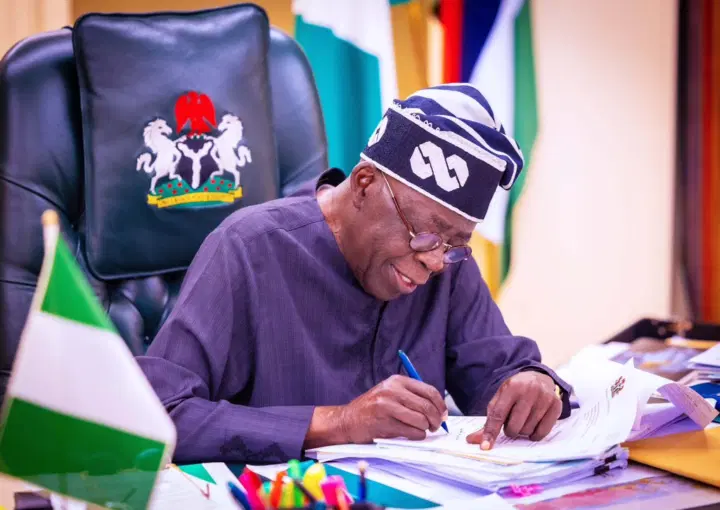
President Bola Tinubu says his administration is now shifting its focus from achieving economic stability to using that stability to drive investment, increase production, create jobs and improve Nigerians’ living standards.
Tinubu made this known on Tuesday at the 19th Annual Banking and Finance Conference in Abuja, where he said the economic reforms introduced by his government were beginning to deliver positive results.
The President, who was represented by the Minister of Finance and Coordinating Minister of the Economy, Taiwo Oyedele, said the banking and financial sector would be vital to achieving the country’s economic transformation.
Tinubu said stability should serve as the foundation for achieving greater prosperity.
He said his administration had implemented difficult reforms in foreign exchange, taxation, public finances and fiscal management to correct structural problems that had built up over several decades.
He pointed to the economy’s 4.43 per cent growth in the second quarter of 2026 and an estimated 17 per cent increase in GDP in US dollar terms during the first half of the year as evidence of progress.
The President also maintained that Nigeria was still on course to reach a $1 trillion economy by 2030, while its purchasing-power GDP had exceeded $2.2 trillion.
He further cited rising external reserves, now above $54 billion, declining inflation, increased investor confidence and positive assessments from international rating agencies as signs of economic improvement.
Tinubu called on banks to move beyond traditional financial intermediation and play a bigger role in transforming the economy by providing more funding to businesses and productive sectors.
He identified economic growth, financial inclusion, technology, long-term financing and public trust as key priorities for creating a stronger and more resilient financial system.
The President also called for deeper development of Nigeria’s capital markets, pension, insurance and asset management industries to attract long-term funding for infrastructure, manufacturing, housing and energy.
He stressed the importance of public confidence in the financial system, saying strong consumer protection and effective regulation were necessary to sustain financial stability.