

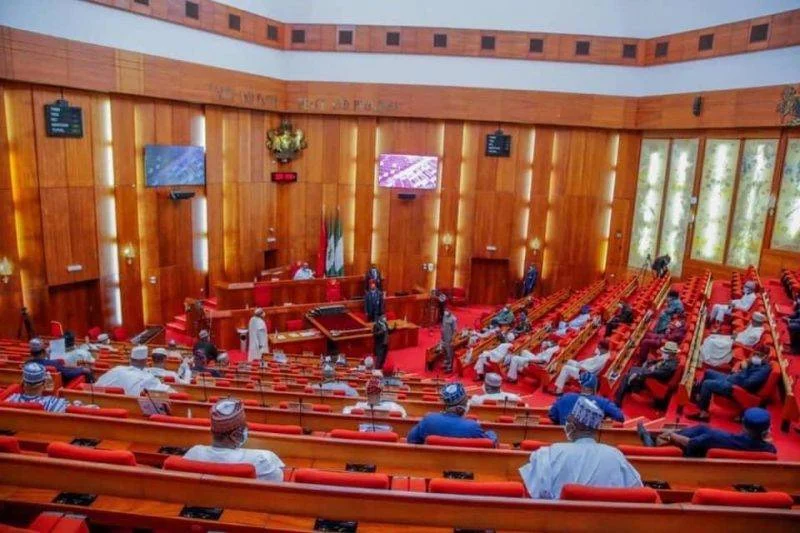

Senate Clears Bamidele, Adaramodu Over Commercial Bus Preaching Bill
The Senate has denied reports linking the Senate Leader, Senator Opeyemi Bamidele, and the Chairman of the Senate Committee on Media and Publicity, Senator Yemi Adaramodu, to the controversial proposal seeking penalties for preaching, hawking and trading inside commercial vehicles.
Reacting to the growing public backlash over the Federal Road Safety Corps (FRSC) Amendment Bill, 2026, Adaramodu clarified that neither he nor Bamidele sponsored or introduced the legislation.
The controversy followed the Senate’s consideration of the amendment bill, which retains a provision prescribing a ₦50,000 fine for anyone convicted of hawking, trading or preaching inside commercial vehicles.
The provision has attracted criticism from religious groups, civil society organisations, opposition parties and many Nigerians, who argue that it is insensitive amid the country’s economic challenges and rising unemployment.
However, the Senate maintained that the provision is not a new attempt to ban religious preaching or evangelism in public transport. According to the upper chamber, the clause has existed in the FRSC Act since 2007 and was merely retained in the amendment bill.
The Senate also clarified that the bill originated from the House of Representatives and was not sponsored by Senator Bamidele.
Adaramodu urged Nigerians not to assume that every debate or proposal in the National Assembly automatically becomes law. He explained that after a bill is considered by the Committee of the Whole, it may be adopted or rejected.
If adopted, the bill is forwarded to the other chamber of the National Assembly for concurrence, where it undergoes another round of legislative scrutiny. Any differences between both chambers are resolved by a joint conference committee before the harmonised version is transmitted to the executive.
He added that the bill is subsequently reviewed by the Federal Ministry of Justice and other relevant agencies before being presented to the President for assent.
According to the senator, only after completing all constitutional and legislative procedures can any bill become law.
Adaramodu also dismissed claims circulating on social media that he and Bamidele were responsible for the controversial provision, describing the reports as false and misleading.